Executive Summary
- Who this is for: Enterprise Architects, CTOs, CIOs, Architecture Leads, Engineering Leaders
- Problem it solves: Strategic intent evaporates between the boardroom and the backlog — with no structured layer to translate it
- Key outcome: A practical three-layer translation model that makes organizational strategy traceable all the way to delivery
- Time to implement: 30–60 days to establish the translation architecture for one strategic priority
- Business impact: Delivery teams that build the right things, investment aligned to strategic intent, and governance that closes the gap between declared strategy and operational reality
The Expedition That Never Left Base Camp
A wealthy patron funds an Everest expedition.
The goal is clear.
Summit within fourteen days.
Return safely.
Plant the flag.
The patron has studied the route maps.
They have funded every piece of equipment.
They know exactly what success looks like.
What they cannot tell the climbing team:
- When to begin each acclimatization rotation.
- How to sequence oxygen cache placement across the mountain.
- Which weather windows align with summit attempt timing.
- Who leads which phase of the ascent.
The objective is real.
Genuinely understood.
Generously funded.
But the objective cannot be handed to the climbing team as a daily instruction.
It has to be translated.
The base camp manager does that work.
They take the expedition goal and produce the schedule, the team assignments, the go/no-go criteria for each phase.
The patron provided the WHAT.
The base camp manager produces the HOW.
Without that translation layer, the expedition does not fail because the goal was wrong.
It fails because the goal was never made executable.
The Strategy That Never Arrived
Every organization runs its own version of this problem.
The board defines the strategy.
Become the most customer-centric platform in our category.
Shift forty percent of workloads to cloud within eighteen months.
Enter three new markets by end of Q4.
The strategy is documented.
Presented.
Approved.
Communicated.
And then something happens.
Or rather — something does not happen.
The strategy does not arrive at the team building the API.
It does not arrive at the architect designing the data model.
It does not arrive in the sprint planning session where priorities get set.
It evaporates somewhere between the boardroom and the backlog.
And when delivery teams ask why their roadmap keeps shifting — why the thing they built last quarter no longer matters — the answer is never that the strategy changed.
The answer is that nobody built the translation layer.
The Three-Floor Building
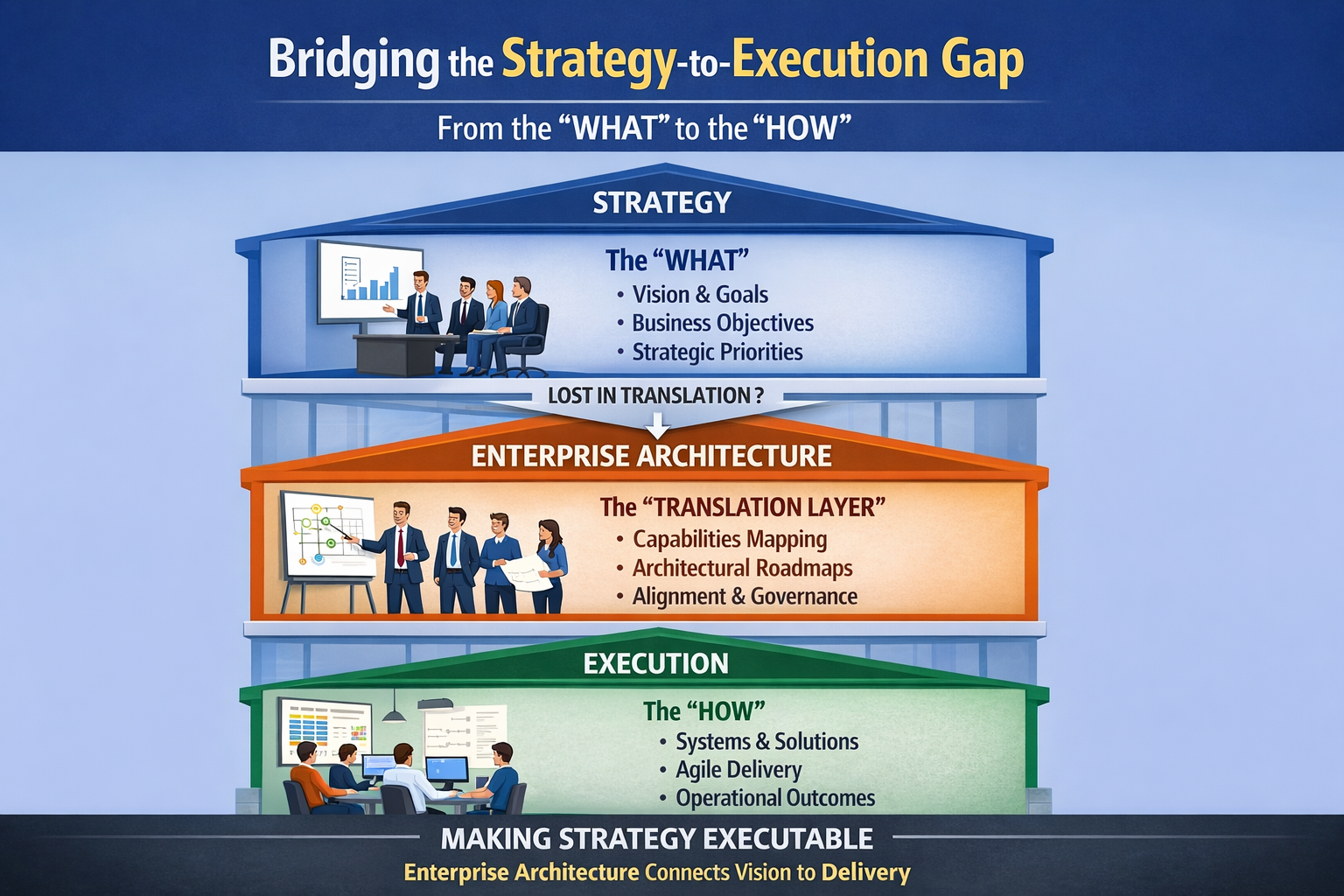
Imagine a three-storey building.
Each floor is occupied. Each floor is busy.
The top floor holds the executive team.
They are working on strategy.
Priorities. Outcomes. Competitive intent.
Decisions about where the organization must go.
The ground floor holds the delivery teams.
Engineers, product managers, delivery leads.
Working on systems. Features. Releases.
Decisions about what gets built this sprint.
The middle floor is the problem.
It exists on every organization chart.
It appears in job titles and in team names.
But in most organizations, it is not doing its job.
The middle floor is where strategy should be translated into capability.
Where intent should become architecture.
Where the WHAT becomes the HOW.
When the middle floor is empty — when Enterprise Architecture is treated as a documentation function rather than a translation function — the gap opens.
Strategy stays on the top floor.
Execution runs on the ground floor.
Nobody builds the staircase between them.
Why the Gap Is Structural, Not Cultural
Most organizations try to close the strategy-to-execution gap with communication.
More town halls.
Better slide decks.
OKRs cascaded to every team.
A strategy page in Confluence everyone is asked to read.
The communication is genuine.
The intent is real.
The gap does not close.
Because the gap is not a communication problem.
It is a structural problem.
Strategy is expressed at the wrong altitude to be executed directly.
"Become customer-centric" is not a system requirement.
"Shift to cloud" is not an architecture decision.
"Enter new markets" is not a delivery plan.
These statements are too abstract for execution.
But they are exactly the right level for strategy.
The problem is the absence of a structured translation layer between them.
That layer is Enterprise Architecture's primary job.
And most EA practices are not doing it.
They are drawing diagrams.
Writing standards.
Approving designs.
But not systematically translating strategic intent into something a delivery team can act on.
The Three Places Strategic Intent Gets Lost
There are three precise moments where the thread snaps.
Strategy defines outcomes.
It does not define which organizational capabilities need to exist, improve, or change in order to deliver those outcomes.
When a strategy declares "become the most customer-centric platform in our category" —
Which capabilities does that require?
Real-time personalization?
Unified customer data across channels?
Complaint-to-resolution in under four hours?
If nobody maps the strategic intent to a set of capabilities, delivery teams make their own interpretation.
Twelve teams make twelve different interpretations.
All of them are working on "customer-centricity."
None of them are coordinated.
Breakpoint 2: Capability Without System Mapping
Even when capabilities are defined, the connection to systems is frequently missing.
An organization may know it needs a Unified Customer Profile capability.
But if nobody maps that capability to the systems that need to be built, replaced, or integrated — the capability remains aspirational.
It exists in the strategy deck.
It does not exist in production.
Breakpoint 3: System Without Decision Mapping
When systems are designed, delivery teams make hundreds of architectural decisions.
Which data model?
Which integration pattern?
Which technology platform?
Which team owns the boundary?
If those decisions are not traceable back to the capability they support — and through the capability back to the strategic intent — they drift.
Over time, technical decisions accumulate that nobody can connect to organizational strategy.
Nobody can explain why the architecture is shaped the way it is.
Nobody can evaluate whether a new proposal moves toward or away from strategic intent.
The thread is gone.
Strategy-Execution Translation Architecture (SETA)
To close the gap, Enterprise Architecture needs to operate as a translation function, not a documentation function.
The model that makes this possible:
Strategy-Execution Translation Architecture (SETA).
SETA is the practice of creating and maintaining explicit, traceable connections across three layers — making organizational strategy continuously executable and auditable at every level.
The Three-Layer SETA Model
Layer 1: The Intent Layer
This is where strategy lives.
Not in its original boardroom language — but translated into architectural intents.
Architectural intents are strategy statements that have been structured into:
- Strategic outcome — what the business is trying to achieve
- Capability implication — which capabilities are required or must change
- Constraint — what boundaries the architecture must respect
- Priority tier — whether this is differentiating, enabling, or foundational
| Strategic Statement | Architectural Intent | Required Capability | Constraint |
|---|---|---|---|
| Become customer-centric | Unified customer experience across all channels | Unified Customer Profile | No channel-specific data silos |
| Cloud shift by 18 months | Eliminate on-premise runtime dependencies | Cloud-native deployment | Zero new on-premise commitments |
| Enter new markets | Localizable, multi-tenant product architecture | Multi-tenancy, Locale Management | No country-specific codebases |
When architectural intents are defined, strategy becomes queryable.
A delivery team can ask: does this design decision support, conflict with, or ignore architectural intent?
Without architectural intents, that question is unanswerable.
Layer 2: The Capability Layer
This is where architectural intents are broken into what the organization must be able to do.
Capabilities are not systems.
Capabilities are not features.
A capability is a stable, named ability that the business needs in order to operate — regardless of which system delivers it.
The Capability Layer maps:
- which capabilities are required by each architectural intent
- which teams own each capability
- which systems currently implement each capability
- which capabilities are missing, duplicated, or unsupported
| Capability | Required By Intent | Owning Team | Supporting System | Status |
|---|---|---|---|---|
| Unified Customer Profile | Customer Centricity | CX Platform | None | Gap |
| Cloud Runtime | Cloud Shift | Platform Engineering | AWS EKS | Partial |
| Locale Management | Market Expansion | Product Core | None | Gap |
| Multi-tenancy | Market Expansion | Platform Engineering | None | Gap |
This layer answers the question that static capability maps never could:
Which capabilities exist in strategy but not in production?
Layer 3: The Execution Layer
This is where capabilities become delivery instructions.
The Execution Layer maps:
- which systems need to be built, replaced, or integrated
- which architecture decisions govern each system
- which delivery programmes are responsible for closing each gap
| Capability Gap | Required System | Architecture Decision | Owning Programme |
|---|---|---|---|
| Unified Customer Profile | Customer Data Platform | Event-sourced, API-first, no direct DB access | CX Transformation |
| Locale Management | Localization Service | Config-driven locale, externalized strings | Market Expansion Sprint |
| Multi-tenancy | Tenant Isolation Layer | Tenant ID in every data boundary | Platform Foundation |
When the Execution Layer is maintained, every delivery team can answer two questions:
- What am I building — and which capability does it close?
- What architectural intent does that capability serve?
The base camp manager exists.
The staircase is built.
The summit objective arrives at the climbing team as a daily schedule.
What Breaks When This Is Ignored
When SETA is absent:
Delivery produces the wrong things at speed.
Teams ship features that no architectural intent requires.
Nobody questions them because nobody can connect the request to a strategic priority.
The organization gets faster at building things that do not matter.
Investment concentrates in the wrong capabilities.
Without capability-to-intent mapping, budget allocations are driven by team visibility, not strategic need.
The quiet load-bearing capabilities go unfunded.
The loud, politically visible ones absorb the investment.
The capability the strategy depends on most is the one nobody funded.
Architecture decisions lose their rationale.
Within eighteen months, nobody can explain why the system is structured the way it is.
New proposals get evaluated in a vacuum.
Every design review becomes a debate without reference to strategic context.
The architecture reflects accumulated momentum, not organizational intent.
When SETA is in place:
Every delivery decision traces back to a strategic intent.
Investment follows capability need, not political visibility.
Architecture reviews have a reference point beyond personal preference.
And the gap between declared strategy and operational reality becomes a managed distance — not an invisible one.
Implementation Guide (30–60 Days)
Introducing SETA does not require a transformation programme.
It requires three structured steps applied to one strategic priority first.
Phase 1: Define Architectural Intents (Weeks 1–2)
Select one active strategic priority.
Translate it from boardroom language into a structured architectural intent.
Work with strategy owners to identify:
- the organizational outcome the strategy is pursuing
- the capabilities that are implied but unstated
- the constraints the architecture must respect
- the priority tier relative to other strategic commitments
Do not attempt this for all priorities simultaneously.
One priority. Fully structured.
Deliverable: Architectural intent card for one strategic priority, including capability implications and constraints
Success Metric: Strategy owner and architecture lead agree the intent card accurately reflects strategic intent. At least two implied capabilities identified that were never explicitly named.
Phase 2: Build the Capability-to-Intent Map (Weeks 3–4)
For each capability implied by the architectural intent:
- Confirm whether the capability exists, is partial, or is absent
- Identify the team that owns — or should own — it
- Map the system that currently implements it (or document the gap)
Use the QCA model if available.
If not, a structured spreadsheet suffices.
The goal is not tooling sophistication.
The goal is answering: which capabilities required by this strategy do not yet exist?
Deliverable: Capability gap map for one strategic intent, with ownership and system coverage per capability
Success Metric: At least one capability gap identified — a capability required by strategic intent with no supporting system and no assigned owner
Phase 3: Connect Gaps to Delivery (Weeks 5–8)
For each capability gap:
- Define the system or architectural change required to close it
- Document the architecture decision that governs that system
- Assign the gap to a named delivery programme with a target resolution date
Introduce a SETA review gate into the architecture governance cycle:
Every new project initiation must declare which architectural intent it serves and which capability it closes.
Projects that cannot answer this question are returned before scope is agreed.
Deliverable: Execution map connecting capability gaps to delivery programmes, with governing architecture decisions per gap
Success Metric: At least one delivery programme rescoped or reprioritized based on capability-to-intent analysis. At least one project initiation document includes intent and capability traceability as required fields.
Evidence from Practice
Organizations that introduce the SETA model for the first time consistently encounter the same three surprises.
The first is the number of strategic priorities with no capability owner.
Not because ownership was neglected — but because the capability was never named explicitly.
The strategy assumed the capability existed.
Nobody checked.
The second surprise is the investment misalignment.
When capabilities are mapped to intents and investment is overlaid, the pattern is consistent.
The capabilities that carry the most strategic weight are rarely the ones receiving the most investment.
The most visible, most frequently discussed capabilities attract funding.
The quiet, load-bearing ones — the ones an entire strategy rests on — are often underfunded or owned by nobody.
The third surprise is how many delivery programmes cannot answer the question.
When asked which strategic intent their programme serves — and which capability gap it closes — most programme leads initially hesitate.
Not because the work is unimportant.
Because nobody ever asked them to make the connection explicit.
The work is real.
The connection to strategy was assumed.
Assumptions are where the gap lives.
Action Plan
This Week
Ask three questions:
- Can your delivery teams name the strategic intent their current work serves — without looking at a strategy slide?
- Can your architecture team identify which capabilities are required by your top strategic priority — but have no supporting system?
- If the board asked tomorrow which delivery programmes are closing the gap between current capability and strategic intent — could anyone answer in under ten minutes?
If these answers are unclear, the translation layer is missing.
Next 30 Days
Select one active strategic priority.
Produce its architectural intent card.
Map the capabilities it requires.
Identify which are missing, partial, or unowned.
Connect each gap to a named delivery programme — or flag that no programme owns it.
That gap register is your strategy-to-execution accountability map.
3–6 Months
Embed SETA as a standard input to all project initiation, investment review, and architecture governance processes.
Require every delivery programme to declare its intent traceability before scope is committed.
Review the intent-to-capability map quarterly alongside the strategy cycle — not annually alongside the architecture review.
Strategy changes faster than annual governance cycles.
The translation layer must keep pace.
Final Thought
The patron funded the expedition.
The goal was clear.
But the climbing team never received a schedule.
Only a summit.
The organization declared the strategy.
The intent was genuine.
But the delivery teams never received a capability map.
Only a vision.
Enterprise Architecture's job is not to document the expedition after it returns.
It is to be the base camp manager before it departs.
The WHAT belongs to the boardroom.
The HOW belongs to the delivery team.
The translation belongs to Enterprise Architecture.
Without it, the expedition is just a very expensive aspiration.
Close the Gap Between Your Strategy and What Gets Built
If your delivery teams cannot trace their work back to a strategic intent…
if capabilities required by your strategy have no owner and no supporting system…
or if architecture reviews debate design decisions with no reference to organizational priority —
your organization may be operating without a translation layer.
In a focused 30-minute Strategy-Execution Diagnostic, we will:
- Identify where strategic intent breaks down in your organization
- Map which capabilities your top strategic priority requires — and which are missing
- Introduce the SETA model for your architecture practice
- Define a 30-day plan to connect your strategy to your delivery programmes
No transformation programme.
No architecture theater.
No strategy slides that never reach the sprint.
Just a translation layer that makes organizational intent executable.
→ Book an Architecture Strategy Session
or
The strategy is on the top floor.
The delivery team is on the ground floor.
The staircase is Enterprise Architecture's job to build.